Chapter 5Tanks and setupsComparison
Aquarium Substrate and Decor: Gravel, Sand, Aqua Soil, Driftwood
Aquarium substrates compared: gravel, sand and aqua soils, how driftwood and limestone change pH, rinsing and safe decor, and silk vs plastic plants for bettas.
We earn from qualifying purchases through links on this page. How we make money.
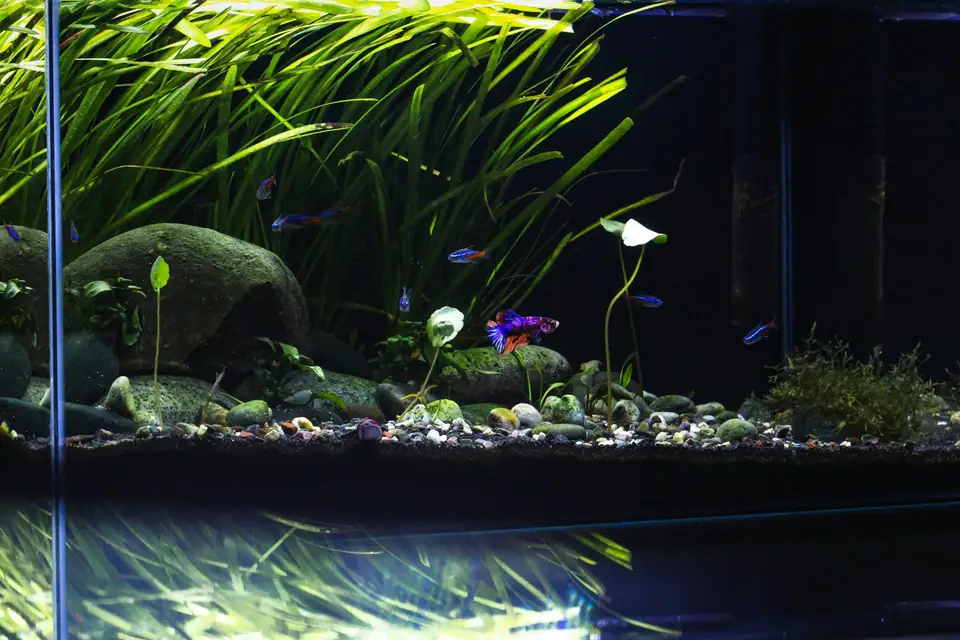
Gravel suits most tanks, sand gives a softer look, and aqua soils such as Fluval Stratum are for planted tanks. Driftwood can lower pH through tannins and limestone raises it, says Aqueon, so match decor to your fish. Rinse substrate before use, never use soap, and choose smooth decor for long-finned fish like bettas.
Substrates compared
| Substrate | What it is | Good for | Watch for |
|---|---|---|---|
| Gravel | Small stones, natural or coated | Most community tanks, easy to vacuum | Sharp grains for long-finned fish |
| Sand | Fine grains | Natural look, bottom-dwelling fish | Packs down; siphon gently |
| Aqua soil | Baked granules made for planted tanks | Live plants and shrimp tanks | Can shift pH; rinse gently |
| Crushed coral or dolomite | Calcium carbonate gravel | Fish that need harder water | Raises pH, says Aqueon |
Aqueon’s setup guide says to rinse gravel with tap water in a colander, wire strainer or fish net, and the Marina kit manual says to rinse gravel and ornaments to remove debris. The Marina manual says to add and spread it carefully, avoiding the walls.
Gravel, sand, aqua soil and hardscape
Live listings, shown by eBay
Opens eBay in a new tab. Check condition, seller feedback and returns.
Aqua soils for planted tanks
Aqua soils are made for rooted plants. Fluval describes its Plant and Shrimp Stratum as collected from volcanic soil near Mount Aso in Japan, porous so that nitrifying bacteria colonize it quickly, and able to support a neutral to slightly acidic pH. It says to rinse it gently in a colander without stirring, only to remove dust.
If you keep fish-only tanks with artificial plants, plain gravel or sand is enough. Live plants are sold by aquarium retailers; follow their care notes for substrate and light, and see aquarium lighting for PAR.
Driftwood, rock and pH
Hardscape changes water chemistry. Aqueon says tannins from driftwood can lower pH, though one or two small pieces will not do much in a large tank or one with strong buffering. Tannins also tint water the color of tea.
Aqueon also says crushed coral and dolomite gravel, and limestone or coral rock as decor, slowly dissolve, raising and buffering pH. Some fish want that and many do not. Before you add a new rock, ask what it is; aquarium-sold rock is labeled.
Aqueon adds that most captive-bred freshwater fish are flexible about pH, and that changing it is generally not necessary and can do more harm than good. Test with a kit (see how to cycle a fish tank) before and after adding wood or rock, and make changes slowly.
Decor that is safe for fins
For bettas, RSPCA Australia asks for smooth gravel and decor without sharp edges, which can damage fins. University of Illinois vets add that decorations should never take up so much of the tank that the fish is pushed to the edges.
- Silk plants are soft and suit long-finned fish.
- Plastic plants vary; run your fingers over them and skip any with sharp seams.
- Hides and caves give shy fish cover; check the openings for rough edges.
- Backgrounds go on the outside of the back glass and hide cords and walls.
Never use soap or detergent on anything that goes in the tank, says the Marina manual; rinse decor in plain water.
Silk plants, leaf hammocks and backgrounds
Live listings, shown by eBay
Opens eBay in a new tab. Check condition, seller feedback and returns.
Setting up substrate and decor, in order
The Marina kit manual and Aqueon’s setup guide give the same order, and it saves redoing work:
- Rinse the substrate in a colander or net until the water runs clearer. Rinse aqua soil gently, as Fluval says, without stirring it.
- Rinse every ornament in plain water, never soap.
- Add the substrate carefully, spreading it without scraping the walls.
- Place rocks, wood and plants on the substrate while the tank is still empty, when heavy pieces are easy to position.
- Fill slowly with room temperature water, then add water conditioner.
Keeping substrate and decor clean
Waste settles into the substrate between water changes. RSPCA Australia pairs each weekly water change with a gravel clean, which means pushing a gravel vacuum into the gravel so the flow lifts waste out while the stones fall back. Sand is lighter, so hold the vacuum just above it. Decor can be rinsed in old tank water during a change; the cleaning chapter has the full routine.
Putting it together
Choose the substrate for your fish and plants, add hardscape with its pH effect in mind, and leave open water to swim in. The betta setup and goldfish setup chapters give species notes, and the setup checklist covers the rest.
Frequently asked questions
Is sand or gravel better for an aquarium?
Both work. Gravel is easy to vacuum and suits most community tanks; sand gives a natural look but packs down and needs a gentle siphon. For bettas, RSPCA Australia asks for smooth gravel with no sharp edges.
Does driftwood lower pH?
It can. Aqueon says tannins released by driftwood can lower pH, but one or two small pieces will not do much in a large tank or one with strong buffering. The tannins can also tint the water brown.
Do I need to rinse aquarium substrate?
Rinse gravel and sand, as Aqueon's setup guide says, in a colander or net. Fluval says to rinse its Stratum aqua soil gently, without agitating it, just to remove fine dust.
Are rocks from outside safe for an aquarium?
Some change the water. Aqueon says limestone and coral rock, like crushed coral substrate, slowly dissolve and raise pH. Unknown rocks can also carry dirt or chemicals, so aquarium-sold rock is the safer choice.
Are silk or plastic plants better for bettas?
RSPCA Australia says bettas prefer several plants, real or artificial, and warns against sharp edges that damage fins. Silk plants are soft; check hard plastic plants for sharp edges before use.
Sources
- Aquarium pH: How to Safely Adjust pHAqueon
- Setting Up a Freshwater AquariumAqueon
- Fluval Plant and Shrimp Stratum (product description)PetSmart
- Marina LED Aquarium Kit instructions (5, 10 and 20 gallon)Rolf C. Hagen, hosted by Chewy
- How should I care for my goldfish?RSPCA Australia
- How should I care for my Siamese fighting fish?RSPCA Australia
- Bettas Need More Than BowlsUniversity of Illinois College of Veterinary Medicine
Part of Tanks and setupsStart here: Fish Tank Supplies Checklist: Everything a New Aquarium Needs
Read next
Fish Tank Supplies Checklist: Everything a New Aquarium Needs
What a new freshwater aquarium needs before fish: tank, lid, filter, heater, light, conditioner, test kit, substrate and food, with sizes from vets and makers.
Betta Fish Tank Setup: Tank Size, Heater, Filter and Decor
How to set up a betta tank: 5 gallons or more, a heater for 76 to 81°F, a gentle filter, a lid and soft decor, from University of Illinois vets and the RSPCA.
Fish Tank Sizes Compared: 5, 10, 20, 29, 40, 55 and 75 Gallons
Standard aquarium sizes side by side: dimensions, empty and filled weights from Aqueon, what each size suits per vets, and the stand and stocking caveats.