Chapter 10Heat and lightComparison
Aquarium Lights: LED, Planted-Tank and Timer Setups Compared
Aquarium lighting explained: light for viewing vs for plants, what PAR means, how many hours a day from the RSPCA, why a timer helps, and where to put the tank.
We earn from qualifying purchases through links on this page. How we make money.
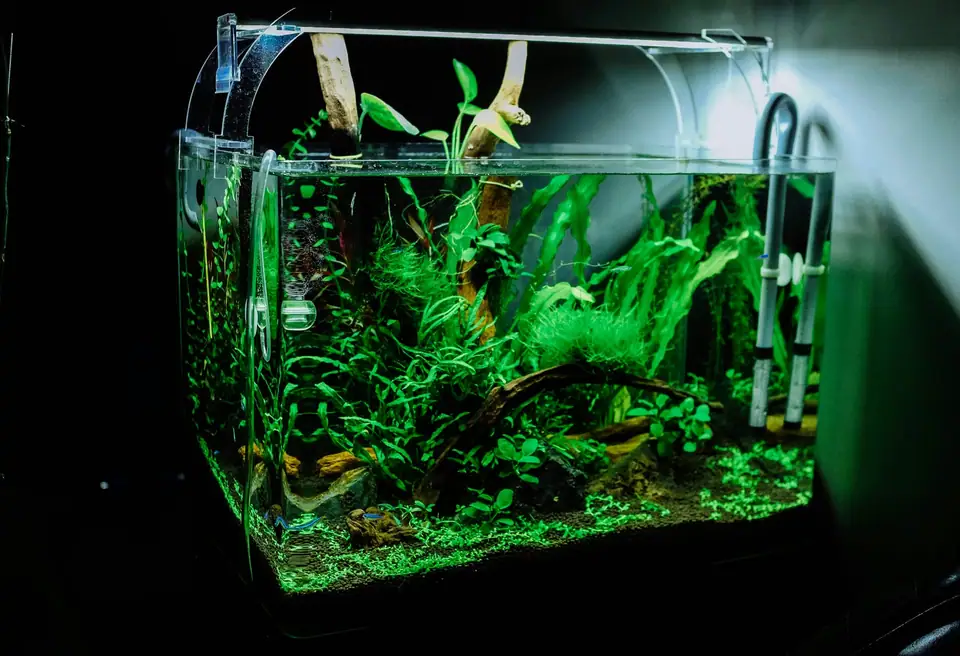
An aquarium light is for viewing, for keeping a steady day and night, and, in planted tanks, for plant growth. The RSPCA suggests 8 to 10 hours of light a day, and RSPCA Australia at least 8 hours of darkness, so a timer is the simplest fix. Keep the tank out of direct sunlight, as VCA advises.
What an aquarium light is for
A light does three jobs, and each asks something different of it:
| Job | What matters | Source |
|---|---|---|
| Viewing the fish | Even coverage across the tank | General |
| Day and night rhythm | The same hours every day, then darkness | RSPCA; Aqueon |
| Growing live plants | Output in the 400 to 700 nm PAR range, reaching the bottom | Science Learning Hub (PAR) |
For a fish-only tank with artificial plants, a basic LED strip or the light in a kit’s lid is enough. The Marina LED kits, for example, build the light into the canopy. Planted tanks need more.
Aquarium LED lights and planted-tank fixtures
Live listings, shown by eBay
Opens eBay in a new tab. Check condition, seller feedback and returns.
How many hours of light?
The RSPCA suggests 8 to 10 hours of light a day on an artificial cycle, and says to avoid placing the tank by a window. RSPCA Australia’s goldfish guidance sets a maximum of 10 hours of light with at least 8 hours of darkness.
Those numbers sit comfortably together: pick a fixed block such as 10 in the morning to 8 at night. Aqueon suggests putting the light on a timer so the cycle stays consistent, which also means the light is off when you are away.
Why sunlight is a problem
VCA says a tank should be shielded from direct sunlight. The RSPCA gives the same advice and prefers an artificial light cycle. Sun through a window adds light you cannot switch off and can warm the water, which unsettles the temperature your heater is holding.
Fixing too much light starts with the timer and the tank’s position, before any cleaning. The cleaning chapter covers algae scrapers for the glass.
Planted-tank lights and PAR
Plants use light between 400 and 700 nanometers for photosynthesis, the range called photosynthetically active radiation, or PAR, as the Science Learning Hub defines it. Light for viewing only needs to look good; light for plants needs enough PAR to reach the substrate.
When you compare planted-tank lights:
- Look for the maker’s published PAR figure at a stated depth, and compare it with your tank’s height.
- Check that the fixture covers the tank’s full length; a short light leaves dim ends.
- Prefer a light with a built-in timer or one you can put on an outlet timer.
Live plants are sold by aquarium retailers, with care notes that describe the light each plant needs; we describe them but do not link them. Artificial silk plants need no special light. The substrate and decor chapter covers aqua soils for planted tanks.
Silk plants and decor that need no special light
Live listings, shown by eBay
Opens eBay in a new tab. Check condition, seller feedback and returns.
A sample schedule on a timer
Here is one way to meet both RSPCA pages with an outlet timer. Shift the times to suit when you are home to watch the tank.
| Time | Light | Why |
|---|---|---|
| 10 a.m. | On | Once the room is already light |
| 8 p.m. | Off | 10 hours on, the RSPCA’s upper figure |
| 8 p.m. to 10 a.m. | Dark | 14 hours, well over RSPCA Australia’s minimum of 8 |
A timer also helps on days you are away: the fish keep the same day and night, which is the consistency Aqueon’s setup guide asks for. If you use a heater and light on the same power strip, give each cord its own drip loop.
Kit lights or a separate fixture?
Some starter kits build the light into the lid. The Marina LED kits, for example, integrate the LED strip into the canopy, powered through a transformer with an on and off switch on the cord, and the manual says to use only the supplied transformer. That is enough for fish and artificial plants.
A separate fixture makes sense when you add live plants, when the lid light does not reach the whole tank, or when you want a built-in timer. Measure the tank’s length before you buy, and check whether the fixture sits on the rim, hangs above it or clips on, as the small nano lights do.
Safety and placement
Light fixtures sit just above the water, so the same rules apply as for heaters and filters. The Marina kit manual says to make a drip loop in the light’s cord, to unplug the light before cleaning it, and to make sure every surface is dry before reconnecting it. For cleaning, it suggests wiping exposed surfaces with a damp cloth to remove dust and mineral deposits, handling the unit with both hands.
Place the tank where you can see it but the sun cannot reach it. For heating, see aquarium heaters, and for the full list of gear, the setup checklist.
Frequently asked questions
How many hours a day should an aquarium light be on?
The RSPCA suggests 8 to 10 hours a day on an artificial cycle. RSPCA Australia's goldfish guidance says a maximum of 10 hours of light with at least 8 hours of darkness.
Do fish need light at night?
No. RSPCA Australia asks for at least 8 hours of darkness, and Aqueon suggests a timer so the day and night cycle stays consistent.
What light do I need for a planted tank?
Plants use light in the 400 to 700 nanometer range, called PAR. Planted-tank lights are sold with more output in that range; compare makers' published PAR figures at your tank's depth, and match the light to the plants the retailer's care notes describe.
Should I put my fish tank near a window?
No. VCA says to keep the tank shielded from direct sunlight, and the RSPCA says to avoid window placement and use an artificial light cycle instead.
Sources
- Choosing an Aquarium: Keeping Pet FishRSPCA
- How should I care for my goldfish?RSPCA Australia
- Pet Fish: Setting Up an AquariumVCA Animal Hospitals
- Setting Up a Freshwater AquariumAqueon
- Photosynthetically active radiation (glossary)Science Learning Hub, University of Waikato
- Marina LED Aquarium Kit instructions (5, 10 and 20 gallon)Rolf C. Hagen, hosted by Chewy
Part of Heat and lightStart here: Fish Tank Supplies Checklist: Everything a New Aquarium Needs
Read next
Fish Tank Supplies Checklist: Everything a New Aquarium Needs
What a new freshwater aquarium needs before fish: tank, lid, filter, heater, light, conditioner, test kit, substrate and food, with sizes from vets and makers.
Aquarium Heaters: Do You Need One, What Size, and Which Type
Which fish need an aquarium heater, what wattage for your tank size from Aqueon's chart, what a heater costs to run at US electricity prices, and heater safety.
Photo: Ewkaa / Wikimedia Commons, CC BY-SA 3.0
Aquarium Filters: Sponge vs Hang-on-Back vs Canister vs Internal
Sponge, hang-on-back, canister and internal aquarium filters compared: how each works, maker tank ratings, upkeep and which suits bettas, goldfish or big tanks.